


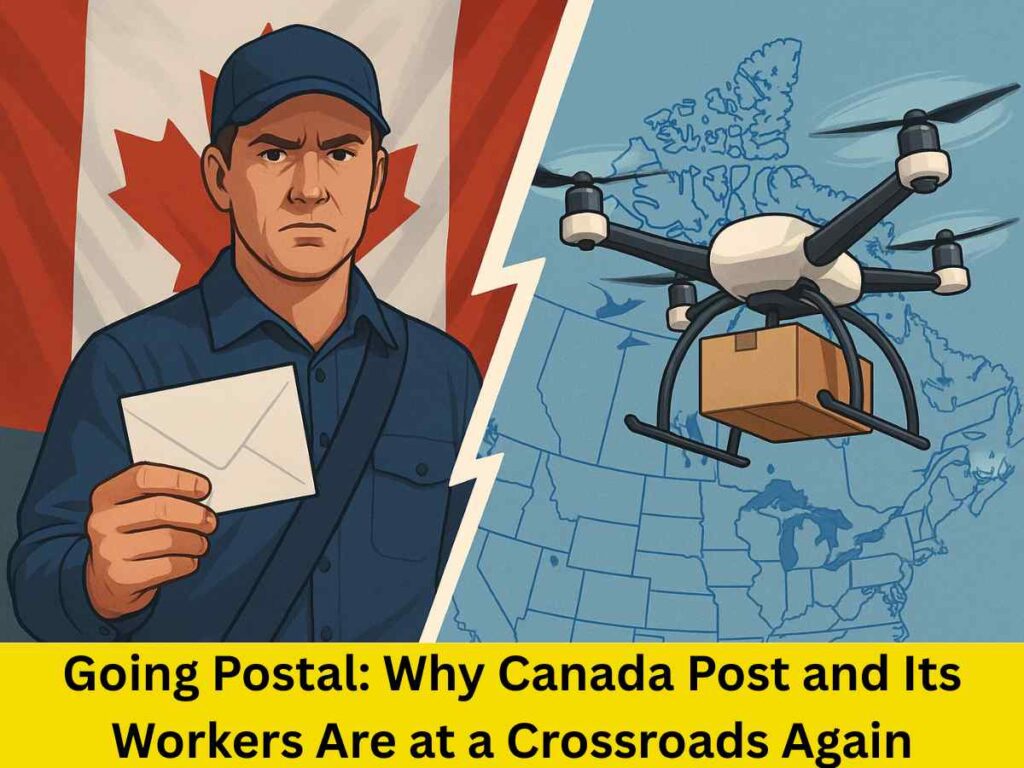
Going Postal: Why Canada Post and Its Workers Are at a Crossroads Again: The familiar sight of a Canada Post truck navigating neighbourhood streets, a friendly wave from a letter carrier – these are threads woven into the fabric of Canadian life. But this summer, that familiar rhythm is under threat. As of July 2025, Canada Post and the Canadian Union of Postal Workers (CUPW), representing approximately 55,000 employees, are locked in a tense standoff. With the union leadership unanimously recommending its members reject the latest contract offer, the spectre of a national postal strike looms large, threatening to disrupt the flow of mail and parcels for millions of Canadians and businesses.
This isn’t just another labour dispute. It’s a battle for the very future of Canada’s postal service, a clash between a historic institution grappling with massive financial losses and a workforce fighting for job security, fair compensation, and a say in a rapidly changing industry. To understand the gravity of the current situation, we need to look back at the militant history of postal strikes in Canada, delve into the core issues on the bargaining table today, and examine the profound impact a work stoppage could have on an already fragile economy.
A Legacy of Labour Unrest: The Militant History of Canada Post Strikes
The Canadian Union of Postal Workers has a long and often confrontational history. Formed in 1965, CUPW’s roots are in activism, famously leading an illegal wildcat strike that same year which ultimately secured collective bargaining rights for all federal public sector employees. This set the stage for decades of assertive negotiations and, at times, significant labour disruptions.
Major strikes in the 1970s focused on wages and job security in the face of new technologies. The 1981 strike was a landmark moment, resulting in CUPW becoming the first federal civil service union to win maternity leave for its members. This was also the year Canada Post was transitioned from a government department to a Crown corporation, a move the union had long advocated for, hoping it would improve labour relations.
While strikes have been less frequent since then, they haven’t disappeared. Rotating strikes in 1987 and 1991 were launched to protest the privatization of postal outlets. The 21st century has seen its own share of turmoil, with rotating strikes in 2011 and again in 2018, the latter being ended by back-to-work legislation. This history of defiance and hard-won gains has forged a union that is not afraid to take a stand, a factor that weighs heavily on the current negotiations.
The 2025 Flashpoint: What’s on the Bargaining Table?
The current contract negotiations, which have been ongoing for 18 months, have reached a critical impasse. In late May 2025, Canada Post presented what it termed its “final offers” to both the Urban Postal Operations and the Rural and Suburban Mail Carriers (RSMC) bargaining units. The union’s response has been a resounding and unified call to reject these offers.
So, what are the key sticking points that have brought us to the brink of a strike?
CUPW’s Demands: A Fight for Fairness and the Future
The union’s demands are rooted in a desire to protect its members’ livelihoods and ensure the long-term viability of a public postal service. Key issues for CUPW include:
- Fair Wages and Cost-of-Living Protection: With inflation eroding purchasing power, a significant wage increase is a top priority for the union.
- Job Security: CUPW is fiercely resisting changes that it believes will lead to the erosion of full-time positions. This includes proposals for a more “flexible” part-time workforce and the use of “dynamic routing,” where delivery routes are created daily by software, eliminating the concept of a carrier “owning” a specific route.
- Pension Security: The union has fought hard to protect the defined-benefit pension plan for its members and is wary of any moves that could weaken it for future hires.
- Health and Safety: CUPW is also focused on workplace health and safety, citing the demanding nature of the job. A seemingly minor issue, such as the elimination of a five-minute wash-up time before meals, is seen by the union as a health and safety concern for workers who handle a wide variety of materials.
- Equality for Rural and Suburban Mail Carriers (RSMCs): For years, RSMCs were classified as contractors, leading to lower pay, fewer benefits, and precarious working conditions. While they are now unionized, significant disparities remain between RSMCs and their urban counterparts. Achieving greater pay equity and better working conditions for these members is a core objective for CUPW.
Canada Post’s Position: A Corporation in Crisis
Canada Post paints a grim picture of its financial situation, a reality that heavily influences its bargaining position. The Crown corporation reported a staggering $1.3 billion operating loss in 2024, part of a multi-billion dollar losing streak over the past several years. The volume of letter mail has plummeted by over 60% since its peak, a decline that e-commerce parcel delivery has not been able to offset financially.
Faced with what it calls an “existential crisis,” Canada Post’s proposals are aimed at modernization and cost-saving. Their key demands include:
- Weekend Delivery and a Flexible Workforce: To compete in the booming e-commerce market, Canada Post wants to introduce weekend parcel delivery. This would be facilitated by a new, more flexible part-time workforce, which the union argues will undermine full-time jobs.
- Operational Changes: The introduction of “unstructured” work and dynamic routing are seen by management as essential for increasing efficiency and reducing costs.
- Containing Labour Costs: While offering a wage increase, Canada Post’s offer is tempered by the need to control its largest expense: labour. The corporation is also looking to make changes to benefits and pension eligibility for new employees to manage long-term liabilities.
The federal government has also stepped into the fray, with the Minister of Jobs and Families approving Canada Post’s request to have employees vote directly on the “final offer,” a move that the union has decried as an attempt to bypass the collective bargaining process and undermine their authority.
The Ripple Effect: What a Postal Strike Means for Canada
A nationwide postal strike would have far-reaching consequences, extending well beyond the inconvenience of delayed birthday cards.
The Impact on Businesses, Especially Small and Medium-Sized Enterprises (SMEs)
For countless Canadian businesses, particularly SMEs and e-commerce entrepreneurs, Canada Post is a lifeline. It offers an affordable and extensive delivery network that private couriers often cannot match, especially in rural and remote areas. A strike would mean:
- Increased Shipping Costs: Businesses would be forced to turn to more expensive private couriers, with some estimates suggesting a 30-45% increase in shipping costs.
- Supply Chain Disruptions: The delivery of essential parts and documents would be halted, potentially leading to production delays.
- Cash Flow Problems: Businesses that rely on mailed invoices and payments would face significant cash flow challenges.
- Customer Service Nightmares: Delayed deliveries inevitably lead to a surge in customer complaints and order cancellations, damaging reputations and bottom lines.
The Impact on Individuals and Communities
While many have transitioned to digital communication and payments, a significant portion of the Canadian population still relies on traditional mail services. A strike would disproportionately affect:
- Seniors and Vulnerable Populations: Many seniors receive essential pension and Old Age Security cheques by mail. While the government has contingency plans, delays are still possible.
- Rural and Remote Communities: In many parts of Canada, Canada Post is the only viable option for receiving goods and communication. A strike would leave these communities feeling even more isolated.
- Those Receiving Essential Documents: From legal notices to medical information, the timely delivery of certain documents is critical. A strike would create uncertainty and potential hardship.
Also check Canada Cracks Down on Immigration Fraud to Protect Newcomers
The Privatization Debate: A Controversial Solution
Lurking in the background of every Canada Post labour dispute is the contentious issue of privatization. Proponents argue that a private postal service would be more efficient, innovative, and less of a burden on taxpayers. They point to the success of privatized postal services in countries like Germany.
However, opponents, including CUPW, argue that privatization would lead to a profit-driven model that would inevitably result in:
- Service Cuts: Less profitable routes, particularly in rural and remote areas, would likely be scaled back or eliminated.
- Higher Prices: Without the mandate to provide a universal service at a uniform price, a privatized entity would likely increase costs for consumers.
- The Erosion of Good Jobs: Unionized, well-paying jobs would likely be replaced with lower-wage, precarious employment.
The debate over privatization highlights the fundamental question at the heart of the current crisis: Is Canada Post a business that needs to be profitable, or is it an essential public service that should be supported as such?
The Road Ahead: A Collision Course or a Path to Compromise?
As the July 2025 deadline for a decision on the contract offer approaches, the tension is palpable. The union’s strong recommendation to reject the offer sets the stage for a potential work stoppage. If the offer is voted down, both sides could find themselves back at the bargaining table, possibly with the assistance of federal mediators, or heading towards binding arbitration.
The coming weeks will be crucial. For Canadians and businesses, it’s a time for contingency planning. For Canada Post and its workers, it’s a moment of truth. Can they find a way to bridge the chasm that divides them and forge a path forward that ensures the survival of a vital Canadian institution while respecting the contributions and rights of its workforce? The answer will determine whether the mail continues to flow or if the nation once again finds itself in the grip of a postal shutdown.