IELTSFever Computer Based Academic Reading Test 10 provides a complete 40-question paper for focused screen-based preparation. This Academic Reading Test 10 moves from marine ecology to industrial art and then to workplace learning. Therefore, it tests careful reading across scientific, historical, and business contexts.
when you can protect one full hour. Treat the paper as IELTS Academic Computer Reading Practice, with a strict timer on a laptop or desktop. Keep the solution page closed, silence notifications, and follow the displayed answer limits.
Open Computer Based Academic Reading Test 10
The first text is the Dugong Sea Cow Reading Passage, which connects feeding, habitat, movement, weather, and human threats. Next, Art in Iron and Steel IELTS Reading explores how artists represented factories, bridges, engineers, and workers. Finally, E-training IELTS Reading weighs the benefits, costs, limitations, and future direction of technology-based instruction.
The paper changes task style often. It begins with exact-word completion, moves into statement logic and short answers, and later introduces paragraph matching, people matching, headings, and a three-option selection. Consequently, one fixed reading habit will not be enough.
This guide introduces a new CLIP Method for Test 10. It explains how to isolate a clue, find its evidence, interpret the relationship, and enter the response correctly. The article protects the answer key, so you can use it before taking the test.
Academic Reading Test 10: Complete Question Map
Academic Reading Test 10 contains eight task groups across three passages. Read the instruction above every new group because the permitted response changes several times.
| Passage | Questions | Verified task groups | Main challenge |
|---|---|---|---|
| The Dugong: Sea Cow | 1–13 | summary completion, True/False/Not Given, short answers | Following biological relationships while obeying two-word and number rules |
| Art in Iron and Steel | 14–27 | paragraph information matching, person matching, summary completion | Linking artworks, artists, structures, viewpoints, and historical details |
| E-training | 28–40 | matching headings, paragraph information matching, three correct options | Separating general benefits, costs, limitations, examples, and future solutions |
Passage 1 and Passage 3 contain 13 questions each. Passage 2 contains 14. Yet question count alone should not control your timing. The last passage includes two paragraph-based tasks and a multi-select group, so it still needs a complete time block.
More full papers are available in the IELTSFever Academic Reading test collection. The Academic Reading practice archive provides further study material. Save both resources for later, since this attempt and its review should come first.
The CLIP Method for IELTSFever Computer Based Academic Reading Test 10
Use the CLIP Method throughout IELTSFever Computer Based Academic Reading Test 10:
Capture → Locate → Interpret → Place
| CLIP stage | Action | Control question |
|---|---|---|
| Capture | Identify the rare clue and the requested relationship | What exactly must I find? |
| Locate | Scan for the evidence zone, not just one familiar word | Which paragraph or lines contain the complete idea? |
| Interpret | Compare meaning, ownership, strength, sequence, and contrast | Does the evidence truly support this answer? |
| Place | Enter the permitted word, number, letter, or numeral | Have I followed spelling and format rules? |
The method separates searching from answering. Many errors occur because a learner sees a shared keyword and clicks immediately. CLIP adds an interpretation stage before the response reaches the answer box.
For IELTS Academic Computer Reading Practice, draw four tiny boxes labelled C, L, I, and P. Use them only for flagged questions. A short note such as “storm—habitat—movement—two words” can preserve the reasoning without copying a full sentence.
Prepare an Instruction Card Before Starting
Spend about 90 seconds reviewing the task groups. On one corner of your note sheet, write this compact card:
- Q1–4: maximum two words;
- Q5–9: True, False, or Not Given;
- Q10–13: maximum two words and/or a number;
- Q24–27: maximum three words;
- Q28–33: Roman numerals; and
- Q38–40: choose three different letters.
This card prevents format loss. It also lets you check the rule without scrolling back to the group instruction.
Next, set a visible 60-minute timer. Adjust the zoom until both the passage and questions feel comfortable. Small text may show more lines, but strained reading can slow you later.
Finally, choose one flag symbol. Reserve it for a question with incomplete evidence or two remaining options. Do not flag an item merely because its topic looks technical.
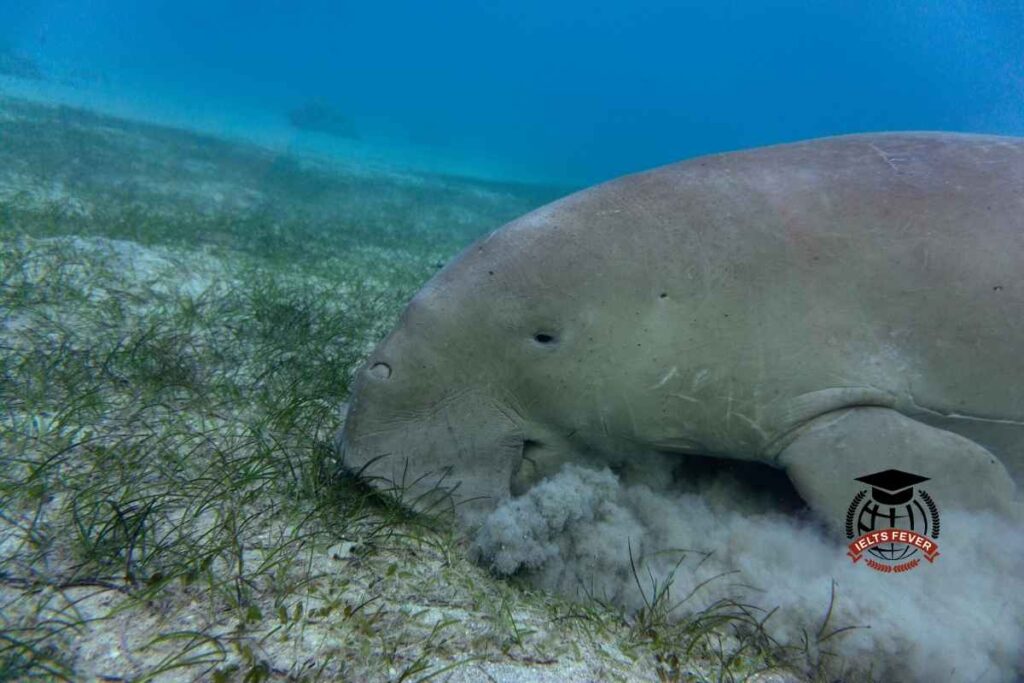
Dugong Sea Cow Reading Passage: Draw a Habitat Web
The Dugong Sea Cow Reading Passage explains an animal through its dependence on seagrass. Feeding preferences affect location. Senses support feeding. Grazing changes plant growth, while food supply influences travel and reproduction. Weather and human activity can then damage the habitat or threaten the animals directly.
Build a Habitat Web with five nodes:
body and senses → food choice → grazing pattern → movement and breeding → population threats
Do not treat the passage as a list of animal facts. Each node connects with another. For example, a habitat change can reduce food, and reduced food can alter movement or reproduction. A question may paraphrase that link rather than repeat one sentence.
Complete the Summary in the Dugong Sea Cow Reading Passage
Questions 1–4 require no more than two words from the passage. The summary moves through feeding preference, sensory ability, grazing evidence, and plant recovery.
First, read all four sentences without filling the gaps. This reveals the sequence and prevents random searching. Then predict the grammar of each blank. You may need a substance, a body feature, a visible mark, or a small part of a plant bed.
Next, Capture the rare clue in each sentence. A phrase about fibre, eyesight, the seabed, or new growth is more useful than the repeated animal name. Locate the relevant paragraph and read one sentence on either side.
Interpret the exact relationship before copying. A body feature used for touch is not the same as a sense used for locating food. Likewise, the mark left by grazing is different from the plant material that remains.
Finally, Place only the essential passage words. Remove articles and optional modifiers if they are not needed. However, keep a two-word expression when both words form the required feature.
Handle True/False/Not Given Through a Proof Split
Questions 5–9 test whether statements agree with the text. Divide each statement into two proof units: the main fact and its limiter.
| Proof unit | What to inspect |
|---|---|
| Main fact | feeding behaviour, recovery, competition, return movement, or fishing risk |
| Limiter | normally, always, rarely, greatest, stronger, coastal, or another controlling term |
Choose True only when both units agree with the passage. Choose False when the text clearly contradicts the claim. Select Not Given when the relationship remains unconfirmed.
Strong words deserve special attention. A passage may say that recovery can take a long time after severe damage. That does not support a claim that every grazed area always needs that period. Similarly, information about a shortage does not automatically establish competition between different animals.
Use the Interpret stage carefully. If one location has a major risk, do not extend that conclusion to every coastal area. Also, do not turn the absence of evidence into a contradiction.
Before placing the verdict, finish this sentence in your mind: “The text states ___, whereas the question claims ___.” That comparison exposes altered frequency, scale, location, or certainty.
Answer Short Questions Without Extra Words
Questions 10–13 allow no more than two words and/or a number. Each item asks for a direct fact, such as a resemblance, a movement factor, a population figure, or a danger.
Capture the noun being requested. Is the answer an animal, cause, number, or object? This prediction stops you from copying a complete explanatory phrase.
For a numerical question, find the correct time marker and location before selecting the figure. Several population estimates may appear close together. Therefore, the number is safe only when its place and period both match the question.
For a cause question, identify whether the passage presents a direct cause, a contributing factor, or a general threat. The broad topic of food may contain a more precise movement trigger.
At the Place stage, count words and preserve the number format. Do not include a unit unless the question or grammar requires it. Then reread the question with your response inserted.
Art in Iron and Steel IELTS Reading: Add Gallery Labels
Art in Iron and Steel IELTS Reading challenges the idea that engineering and art must remain separate. The passage moves among factories, bridges, railway scenes, portraits, construction projects, photographers, and painters.
Create a Gallery Label for each useful paragraph:
subject | creator | medium | message
The subject may be a structure, factory, worker, machine, or construction process. The creator is the artist or photographer. Its medium could be a painting, photograph, drawing, or engraving. Finally, note the message explaining why the work matters.
This label prevents a common mix-up. Two artists may depict engineering, yet one celebrates scale while another focuses on individual workers. The topic is shared, but the viewpoint differs.
Locate Paragraph Information in Art in Iron and Steel IELTS Reading
Questions 14–18 ask which paragraph contains a particular detail. A correct match needs the requested relationship, not merely the same object.
Start by classifying the clue. Does it concern a new relationship between art and engineering, objects of different scale, working conditions, an unfinished project, or structures that symbolise cities?
Now Capture the least repeated element. Words such as art, engineering, and bridge occur often. By contrast, unfinished work, working conditions, city identity, or a contrast in scale can lead to a smaller evidence zone.
After locating a likely paragraph, Interpret its purpose. One paragraph may describe a structure directly. Another may describe how an artist presented it. The question will reveal whether it wants the physical object, artistic treatment, or cultural meaning.
Paragraph letters may repeat if the instruction permits it. Consequently, never eliminate a paragraph just because you used it once. Let evidence control every match.
Match People by Their Artistic Signature
Questions 19–23 ask you to connect an opinion or deed with the correct person. Give each name an Artistic Signature consisting of one subject and one action.
| Signature part | Possible note type |
|---|---|
| Subject | factory, bridge, railway, portrait, engineering scale, or workers |
| Action | painted, photographed, illustrated, praised, documented, or interpreted |
Names can appear in a paragraph with other people or structures. Therefore, follow reporting verbs and possessive forms. The nearest name may not own the quoted view or artwork.
Also, distinguish a creator’s medium. A person who paints an industrial site is not automatically the photographer who records dangerous working conditions. Similarly, someone who praises engineering in words may also create images, but the question may target the opinion rather than the artwork.
Use a two-link proof before placing a letter: correct person plus correct artistic signature. If only the general topic matches, keep checking.
Complete the Bridge Summary in Three Words or Fewer
Questions 24–27 focus on one famous engineering structure. The gaps request a designer, an earlier material, a river name, and a museum or display location. Each answer allows no more than three words.
Read the entire summary first. Then draw a Structure Card:
builder → previous materials → location → later display
The card follows the summary order. Locate the compact section discussing the bridge and read through it once before filling any gap.
Grammar will help. A blank after was may need a person’s name. A phrase after made from needs a material. Another position may require a proper geographical name or institution.
Copy the wording exactly from the passage rather than relying on memory. Proper names require careful spelling. Finally, count every word and test the completed sentence for natural grammar.
E-training IELTS Reading: Use a Benefit–Cost–Fit Board
E-training IELTS Reading presents both advantages and limitations. It discusses savings, convenience, consistency, self-paced study, multimedia, learner performance, development costs, bandwidth, unsuitable topics, and blended learning.
Organise these ideas on a Benefit–Cost–Fit Board:
| Column | Reading question |
|---|---|
| Benefit | What improves, becomes cheaper, or becomes more flexible? |
| Cost | What requires money, time, systems, or maintenance? |
| Fit | Which learning goals suit or do not suit online delivery? |
| Future | How might online and face-to-face methods work together? |
This board prevents you from treating the passage as a simple argument for technology. The writer recognises value but also sets boundaries. That balanced position controls the headings and final selection task.
Select Headings in E-training IELTS Reading
Questions 28–33 ask for headings for paragraphs A–F. Each answer must be entered as a Roman numeral.
Read the paragraph before examining the options closely. Write a private summary containing a topic and purpose, such as “cost savings overview,” “benefits beyond money,” “learning results,” “development burden,” “poor fit,” or “future combination.”
Next, compare that summary with the heading list. A heading must cover the paragraph’s dominant function. One successful company example may support a broader paragraph about benefits without becoming its main idea.
Contrast markers are powerful. A paragraph may begin with advantages and then introduce a serious cost. If most of the paragraph explains that burden, the heading should reflect the cost rather than the optimistic opening.
Finally, use elimination only after interpretation. Two headings may share vocabulary, yet one describes a general overview while another names a specific limitation. Place the numeral only when scope and paragraph purpose both agree.
Find Specific Information After the Heading Work
Questions 34–37 ask which paragraph contains a particular detail. Unlike headings, these questions target one piece of information rather than the main idea.
Reuse your paragraph summaries as a search index. However, do not assume that the heading answer automatically solves the information match. A minor example may live inside a paragraph with a different overall purpose.
Capture the most distinctive relationship: a successful programme, corporate flexibility, a future blend, or very fast electronic delivery. Then scan for the evidence zone.
Read the full sentence around any company or technology example. The question may focus on the outcome, while the paragraph names the method and organisation separately.
At the Place stage, enter a paragraph letter rather than a Roman numeral. This format change occurs immediately after the heading group, so check the instruction card before typing.
Choose Exactly Three Limitations
Questions 38–40 use one option list and require three correct letters. Treat them as one three-answer set, not three unrelated multiple-choice questions.
First, Capture the target category: genuine limitations or drawbacks of e-training. Next, Locate the paragraph that concentrates on situations where online delivery is costly, restricted, or unsuitable.
Test every option independently. Place each choice into one of three temporary groups:
- directly supported limitation;
- contradicted by the passage; or
- not presented as a limitation.
Do not choose an option merely because it sounds realistic. The passage must identify that issue. Also, separate classroom disadvantages from e-training disadvantages. An item may describe a real training problem but assign it to the wrong delivery method.
Once three options have direct proof, enter each letter once. Then confirm that you have not duplicated a letter across the three boxes.
A 60-Minute Route for IELTS Academic Computer Reading Practice
Follow this schedule during IELTS Academic Computer Reading Practice:
| Time | Reading target | CLIP priority |
|---|---|---|
| 0:00–1:30 | Review task instructions | Capture formats and limits |
| 1:30–19:30 | Complete the dugong passage | Locate facts and control statement strength |
| 19:30–40:30 | Complete the art passage | Interpret paragraph roles and ownership |
| 40:30–56:30 | Complete the e-training passage | Separate headings, details, and limitations |
| 56:30–60:00 | Conduct a format-first review | Place missing or corrected responses |
Passage 2 receives an extra minute because it contains 14 questions and several artists. Still, the schedule is flexible. If Passage 1 finishes early, transfer that time to the final multi-select task.
Use a two-scan limit. Scan once with the rare clue and once with a likely paraphrase. If the evidence still does not appear, flag the item and continue.
During the last three and a half minutes, inspect blanks first. Then check word limits, Roman numerals, paragraph letters, and duplicated multi-select options. Revisit difficult meaning only after these mechanical risks are clear.
Make Screen Notes with Micro Labels
Long notes slow computer reading. Instead, write micro labels containing two or three words.
For the dugong text, label relationships such as “food—travel” or “storm—habitat.” For the art passage, use “artist—workers” or “bridge—symbol.” For e-training, try “saving,” “flexibility,” “cost,” “poor fit,” and “blend.”
These labels create a quick retrieval path. They also reduce unnecessary scrolling when a later question returns to the same paragraph.
Highlight relationships rather than isolated nouns. Pair a threat with its effect, an artist with a subject, or a training method with a limitation. When you return, the evidence will remain meaningful.
You can build interface confidence in the IELTSFever computer-based practice centre. Repeated IELTS Academic Computer Reading Practice helps navigation become automatic.
Paraphrase Connections in Academic Reading Test 10
Academic Reading Test 10 converts detailed passage language into compact question phrases. Search for relationships behind the vocabulary.
Typical transformations may include:
- a plant controlling animal distribution becoming habitat dependence;
- damage to feeding areas becoming food shortage;
- a structure representing a city becoming an urban symbol;
- an artist recording labour becoming documented working conditions;
- costs beyond teaching becoming development burden;
- learning at a chosen pace becoming flexible delivery; and
- combining two methods becoming blended instruction.
These examples explain paraphrasing; they do not publish test answers. First, identify the type of link. Next, predict possible synonyms. Then locate and interpret the complete evidence.
Do not stop at one shared noun. A passage and question may both mention cost, but one refers to travel savings while the other concerns course production. The relationship decides the match.
Common Traps in IELTSFever Computer Based Academic Reading Test 10
Ignoring the Difference Between Habitat and Direct Threat
The Dugong Sea Cow Reading Passage describes damage to food resources and dangers to the animal itself. Keep these pathways separate.
Converting “Can” into “Always”
A possible long recovery does not prove that every area needs the same period. Check the statement’s strength before choosing a verdict.
Copying an Explanation into a Short Answer
Questions 10–13 need a short fact. Extra words may exceed the limit even when the idea is correct.
Matching Every Bridge Reference to One Paragraph
In Art in Iron and Steel IELTS Reading, bridges can appear as structures, artworks, symbols, or unfinished projects. Interpret the requested role.
Losing the Creator Inside a Busy Paragraph
Several people may appear near one artwork or quotation. Follow the action verb to its true owner.
Using a Heading as an Information Answer Automatically
In E-training IELTS Reading, a small example may appear inside a paragraph with a broader heading. Recheck the specific detail.
Selecting a Plausible but Unstated Drawback
The final options must come from passage evidence. Real-world logic cannot add a limitation that the writer does not present.
Entering the Right Idea in the Wrong Format
Roman numerals, paragraph letters, words, and numbers all occur in this paper. Consult the instruction card before placing each response.
Review with a CLIP Replay Card
After the timed attempt, open the IELTSFever Test 10 solution page. For every incorrect or guessed response, complete a CLIP Replay Card.
| Replay field | Review prompt |
|---|---|
| Capture | Did I select a useful clue or only a broad topic word? |
| Locate | Did I search the correct paragraph and read enough context? |
| Interpret | Did I understand the relationship, strength, ownership, or scope? |
| Place | Did spelling, length, letter type, or number format cause the loss? |
Mark only the first failed stage. If the clue was too broad, later interpretation never had a fair chance. If the evidence was correct but the response was too long, your Place stage needs work.
Next, close the solution and solve the question again. Explain the evidence in one sentence. Then state why the nearest alternative is weaker.
Use the IELTSFever band score calculator after review. Record the raw score, estimated band, weakest CLIP stage, and question group that used the most time.
A 72-Hour Improvement Loop
Hour 0: Timed Baseline
Complete Academic Reading Test 10 without pausing the timer. Mark unsupported guesses, but do not open explanations.
Hour 24: Relationship Repair
Rebuild the Habitat Web, Gallery Labels, and Benefit–Cost–Fit Board. Redo every wrong question using the correct passage model.
Hour 48: Format Sprint
Practise only completion, short-answer, numeral, and letter entry. Set a ten-minute limit and check every response against its instruction.
Hour 72: Closed-Book Retest
Return to your original mistakes and flags. Solve them without viewing the solution. Require a clear Capture, Locate, Interpret, and Place chain for each answer.
Support your reading practice with other modules. The Academic Writing Task 1 resources help you describe relationships concisely. Meanwhile, the IELTS Listening sample papers strengthen accurate word and number entry.
IELTS Academic Computer Reading Practice: Last-Screen Audit
At the last screen, work through this list before submitting:
- All 40 questions contain a response.
- Questions 1–4 use no more than two words each.
- True/False/Not Given decisions rely only on passage evidence.
- Questions 10–13 use no more than two words and/or a number.
- Population figures belong to the correct place and time.
- Paragraph matches express the requested relationship.
- Person matches connect the creator with the correct subject or view.
- For Questions 24–27, each response uses no more than three words.
- Roman numerals appear in Questions 28–33.
- Paragraph letters appear in Questions 34–37.
- The final three boxes contain supported and non-duplicated letters.
- Final changes come from stronger evidence rather than nervous doubt.
Submit when the timer ends. A strict result reveals your true pace and accuracy. Therefore, use the score as a training diagnosis rather than a judgment of ability.
Frequently Asked Questions About Academic Reading Test 10
Question 1:- How many questions are in Academic Reading Test 10?
Academic Reading Test 10 contains 40 questions across three passages. Complete the paper and final checks within 60 minutes.
Question 2:- How should I approach the Dugong Sea Cow Reading Passage?
For the Dugong Sea Cow Reading Passage, connect body features, food, grazing, movement, breeding, and threats in a Habitat Web. This reveals relationships that individual keywords can hide.
Question 3:- What is difficult about Art in Iron and Steel IELTS Reading?
Art in Iron and Steel IELTS Reading includes many creators and engineering subjects. Gallery Labels keep each person, medium, subject, and message together.
Question 4:- What is the best strategy for E-training IELTS Reading?
Organise E-training IELTS Reading by benefit, cost, suitability, and future direction. This structure helps with headings and the final three-option group.
Question 5:- What word limits appear in Test 10?
The first summary allows two words, while the first passage’s short answers allow two words and/or a number. The bridge summary permits three words.
Question 6:- Can I use the same paragraph more than once?
Follow the exact instruction shown above each matching group. Do not invent a one-use rule when repetition remains possible.
Question 7:- When should I view the official solution?
Open it only after a complete timed attempt. Otherwise, you cannot measure independent comprehension or decision speed.
Question 8:- How often should I complete IELTS Academic Computer Reading Practice?
Schedule one full computer-based paper every week and review it carefully. Between full attempts, practise your weakest CLIP stage for ten to fifteen minutes.
Start IELTSFever Computer Based Academic Reading Test 10
Apply the CLIP system now to IELTSFever Computer Based Academic Reading Test 10. Capture a useful clue, locate the full evidence, interpret the relationship, and place the answer within its rule.
Begin Academic Reading Test 10 now. Keep the 60-minute limit honest and complete your CLIP Replay Cards after reviewing the result.
Follow IELTSFever through its official social profiles:
Discover more from IELTS Fever
Subscribe to get the latest posts sent to your email.