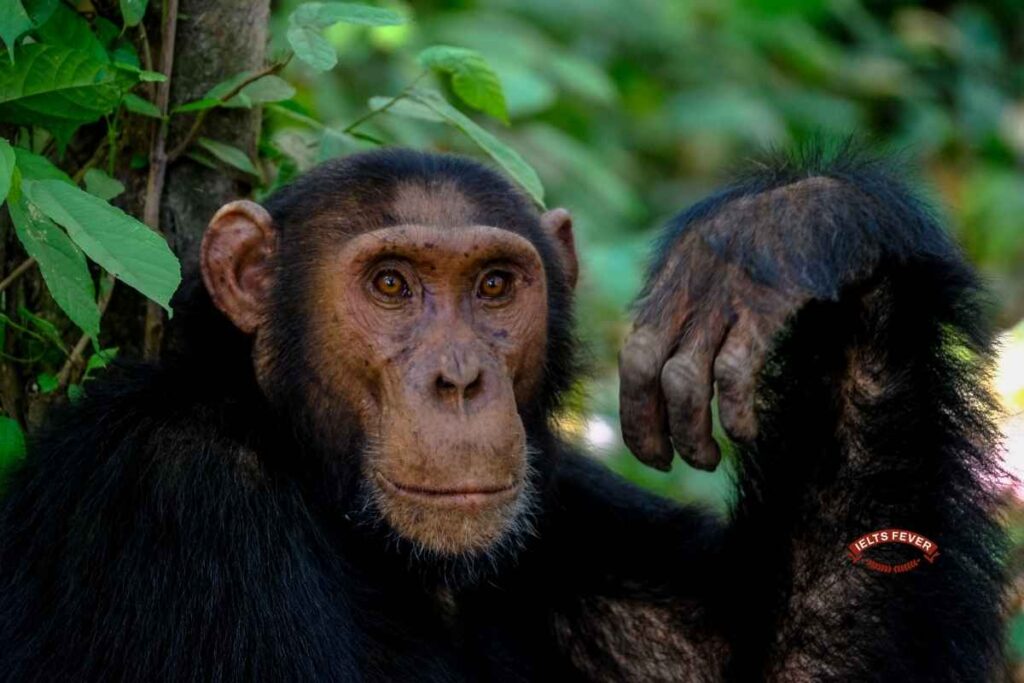
IELTSFever Computer Based Academic Reading Test 2 gives you a complete 40-question reading workout on three contrasting subjects. First, you examine how researchers study cultural behaviour in chimpanzees. Next, you follow the changing purpose of seed collection. Finally, you evaluate the practices and limitations of an island eco-resort.
Although the subjects differ, the passages share one hidden pattern: each text asks you to separate two related ideas. For example, observed behaviour is not automatically culture. Similarly, the largest seed bank is not necessarily the earliest. An environmentally focused resort may also have operational limits.
Therefore, this guide uses a Contrast Pair Strategy. It helps you notice the exact difference that settles a question. The article is original and spoiler-free, so it does not reproduce the full passages or disclose the answer table.
Start IELTSFever Computer Based Academic Reading Test 2
IELTSFever Computer Based Academic Reading Test 2 Overview
| Test feature | Confirmed practice structure |
|---|---|
| Delivery mode | Computer-based Academic Reading |
| Suggested time | 60 minutes |
| Total questions | 40 |
| Passage 1 | Chimpanzee behaviour, culture and research methods |
| Passage 2 | Seed collecting, conservation and storage |
| Passage 3 | Island history, resort operations and sustainability |
| Main tasks | Paragraph matching, True/False/Not Given, short answer, summary completion and multiple choice |
| Review point | Open the solution after the timed attempt |
Before you begin, remove avoidable interruptions. Moreover, use a screen size that lets you read both the passage and questions comfortably. Keep the entire hour free so your timing result remains meaningful.
Next, check that the browser zoom feels natural. However, do not keep changing it during the test. Frequent layout changes can disturb your place in the passage.
Why Academic Reading Test 2 Feels Different
Academic Reading Test 2 does not rely on one dominant question type. Instead, it moves through matching, truth judgements, short answers, summaries and several forms of option selection.
Consequently, your search behaviour must change several times. Paragraph matching requires broad navigation. By contrast, short answers demand a narrow evidence window and an exact word limit.
Passage 2 adds another challenge. It compares historical collecting with modern conservation while also discussing profit, extinction and funding. Therefore, a statement may sound correct but combine details from different paragraphs.
Passage 3 includes five single-answer questions and a final choose-three set. As a result, you must distinguish individual options from a shared option bank.
Complete Question Map for Academic Reading Test 2
The map below explains the live test sequence without revealing answers.
Passage 1 Covers Questions 1–14
Questions 1–5 locate information in paragraphs G–K of the Culture of Chimpanzee Reading Passage. Then, Questions 6–10 use True/False/Not Given. Finally, Questions 11–14 require short answers of no more than three words and/or a number.
Passage 2 Covers Questions 15–27
Questions 15–20 test True/False/Not Given in Seed Hunting IELTS Reading. Afterward, Questions 21–25 complete a summary with no more than three words. Questions 26–27 select two correct choices from one list.
Passage 3 Covers Questions 28–40
Questions 28–32 are four-option questions based on Eco-Resort Management Reading. Next, Questions 33–37 complete a summary with no more than two words. Lastly, Questions 38–40 select three correct statements from a shared list.
Because the answer limits change, read the instruction above every new set. Otherwise, a correct phrase may become an incorrect entry.
The Contrast Pair Strategy
The Contrast Pair Strategy turns a crowded paragraph into one clear decision. First, identify the two ideas that the question might confuse. Then, write or think of a short divider between them.
| Idea A | Divider | Idea B |
|---|---|---|
| published behaviour | versus | behaviour not reported |
| learned trait | versus | genetic inheritance |
| historical collecting | versus | modern conservation |
| largest depository | versus | earliest institution |
| stated green practice | versus | complete sustainability |
| present market | versus | modelled target market |
Next, locate the sentence that explains the divider. For instance, the passage may use however, rather, only, unlike, although or instead. These signal words often contain the decisive evidence.
Finally, confirm the required format. Thus, the method has three moves: build the pair, find the divider and enter the answer correctly.
This strategy gives IELTSFever Computer Based Academic Reading Test 2 its own approach. In addition, it prevents broad topic matching from replacing careful meaning.
Culture of Chimpanzee Reading Passage: Separate Behaviour From Culture
The Culture of Chimpanzee Reading Passage begins with similarities between humans and chimpanzees. However, its central issue is more specific. Researchers want to know whether a behaviour forms a local tradition that members can learn and pass on.
Therefore, create this contrast pair:
one observed action versus a repeated, socially learned pattern
The distinction matters because a rare event may not represent a community’s culture. Similarly, an inherited trait is different from an action learned by watching others.
The passage also changes direction. Early paragraphs discuss discoveries, cultural meaning and conservation. Later paragraphs examine weaknesses in earlier research and describe a broader survey method.
As a result, paragraph purpose matters as much as content. A paragraph may introduce the research flaw, explain its causes, present a solution or list classification categories.
Paragraph Matching in the Culture of Chimpanzee Reading Passage
Questions 1–5 limit your search to paragraphs G–K. Therefore, do not waste time scanning the complete passage for those answers.
Give each target paragraph a short action label. For example, use labels such as changes an attitude, states the old problem, details the weaknesses, builds a new list and classifies observations.
Next, underline the action inside each prompt. A “problem” differs from “reasons for the problem.” Likewise, a “new system” differs from the categories used after that system collects data.
Moreover, one paragraph can mention research without containing the requested stage. Therefore, match the paragraph’s job rather than a repeated noun.
If two letters remain possible, compare the verbs. Words such as overlooked, remedied, distributed and classified point to different steps in the research process.
True/False/Not Given in the Chimpanzee Text
Questions 6–10 shift from paragraph purpose to claim accuracy. First, isolate the statement’s time, degree and comparison. Then, look for evidence that addresses all three.
Future claims need special care. A passage may compare present complexity without predicting that two cultures will become equal. Therefore, do not convert a current comparison into a future certainty.
Also, distinguish most from all. A statement about a high proportion is not automatically a statement about every case. Similarly, sharing genetic material does not prove every behavioural claim.
Use these rules:
- True means the complete meaning agrees;
- False means the text gives an incompatible meaning;
- Not Given means the text does not settle the full statement.
Consequently, missing evidence is not the same as opposite evidence.
Short Answers in the Culture of Chimpanzee Reading Passage
Questions 11–14 allow no more than three words and/or a number. Therefore, begin by predicting the answer class.
| Question clue | Expected class |
|---|---|
| “When” | date, decade or time phrase |
| “In which country” | place name |
| “What did they become accustomed to” | noun phrase |
| “What term” | quoted or named expression |
Next, scan for the named researcher, event or time reference. Then, read the surrounding sentence because the exact answer may sit beside the anchor.
Do not rewrite the wording unnecessarily. Instead, copy the smallest phrase that answers the question and respects the limit. Finally, check spelling before moving on.
With this routine, the Culture of Chimpanzee Reading Passage becomes a controlled search rather than a memory test.
Seed Hunting IELTS Reading: Track the Changing Purpose
Seed Hunting IELTS Reading moves from historical exploration to urgent conservation. At the same time, it contrasts commercial collection with the protection of threatened plant life.
Build two purpose pairs:
| Earlier or commercial purpose | Modern conservation purpose |
|---|---|
| expand collections or seek useful species | protect diversity before it disappears |
| obtain future products | preserve material for restoration and research |
However, do not force every paragraph into one side. Some sections explain storage, plant benefits, global coverage or financial pressure.
Therefore, give the passage a simple route: collectors, modern mission, storage, extinction risk, benefits, insurance role and funding. This route helps you relocate evidence quickly.
Truth Judgements in Seed Hunting IELTS Reading
Questions 15–20 contain tempting upgrades. For example, largest may become earliest, or a major reason may become the only reason.
Consequently, circle superlatives and exclusives in your mind. Words such as first, only, all, largest and earliest require exact proof.
The passage also compares farming storage with modern conservation. Therefore, check whether a statement claims similarity of principle or complete identity of purpose.
Moreover, funding appears late in the passage. A statement about financial limits may be supported far from the earlier description of the main project.
Do not stop at the first related paragraph. Instead, scan the complete topic route and compare the full statement with the best evidence.
Summary Completion in Seed Hunting IELTS Reading
Questions 21–25 form a short account of why seeds are collected and how the work developed. First, read the complete summary. Then, identify whether each blank needs an outcome, product, group, person or location.
Grammar provides a useful filter. For example, a blank after from may require a danger or outcome. By contrast, a blank after included may name a group.
Next, follow the passage order. These questions move through the opening history and later storage information. Therefore, do not restart from paragraph A after every blank.
Names need extra attention. Moreover, multiword locations can lose marks through an added article or spelling error. Copy only what the gap and instruction allow.
Thus, Seed Hunting IELTS Reading rewards both chronological tracking and exact entry.
Selecting Two Answers for Questions 26–27
The same option list serves two numbered fields. Therefore, identify two independently supported benefits before entering either letter.
Use a proof table:
| Option | Explicitly provided by plants? | Evidence quality |
|---|---|---|
| A | yes, no or unclear | direct, implied or absent |
| B | yes, no or unclear | direct, implied or absent |
| C | yes, no or unclear | direct, implied or absent |
| D | yes, no or unclear | direct, implied or absent |
| E | yes, no or unclear | direct, implied or absent |
However, do not use general knowledge. The option must match what the passage explicitly says plants provide.
Once two choices have separate proof, place one in each field. Finally, ensure you did not enter the same letter twice.
Eco-Resort Management Reading: Follow Cause and Result
Eco-Resort Management Reading combines island history, transport, accommodation, water, energy and long-term management. Therefore, a cause-and-result chain is more useful than a simple topic list.
For instance, an earlier event weakens land, and a later natural process changes the island. Likewise, an environmental risk leads the resort to move an activity elsewhere.
Use this four-column guide:
| Situation | Action | Immediate result | Remaining limitation |
|---|---|---|---|
| offshore location | organised water transport | regular access | dependence on that route |
| limited freshwater | restrict water-intensive activity | lower local pressure | continued need to monitor use |
| energy demand | combine alternative systems | reduced impact | some inefficient equipment |
| business growth | apply sustainability ideas | recognised practices | future capacity concerns |
These broad categories organise the passage without giving the answers. Moreover, they keep positive claims separate from remaining weaknesses.
Multiple Choice in Eco-Resort Management Reading
Questions 28–32 each require one option. First, identify whether the question asks about cause, purpose, method, energy source or future management.
Next, remove options that answer a different question. For example, a detail about cost cannot answer a question about protecting water unless the passage makes that connection.
Also, watch multi-stage causes. An initial human event and a later natural process may work together. Therefore, an option that mentions only one stage may be incomplete.
Finally, test the whole wording. One correct noun cannot rescue a wrong cause or outcome. This habit is central to Eco-Resort Management Reading.
Eco-Resort Summary Completion for Questions 33–37
The summary focuses on access, internal transport and accommodation details. Consequently, the evidence sits within a compact section of the passage.
First, note the two-word maximum. Then, predict the answer form from the grammar. A phrase after by may name transport, while a phrase after for may name a user or purpose.
Moreover, nearby objects can compete for one blank. Read the full completed sentence before you submit it. If the grammar sounds wrong, return to the evidence.
Because the answers follow a descriptive sequence, continue forward after each confirmed item. However, do not copy an adjective unless the gap requires it.
Choosing Three Statements at the End
Questions 38–40 use one option bank and require three correct statements. Therefore, assess all five choices before typing.
Create three labels:
- supported now;
- contradicted now;
- future recommendation or limit.
Some options may describe the model rather than the resort’s present reality. In contrast, another option may report a current practice. A third may express a future constraint.
Thus, time reference becomes decisive. Also, check the subject of each claim: the resort, its visitor market, its accommodation standard or its environment.
After selecting three, prove them separately. Finally, place one letter in each numbered box and check for accidental duplication.
Computer Based IELTS Academic Reading: Screen Control
Good Computer Based IELTS Academic Reading practice includes deliberate navigation. First, keep the active question number visible whenever possible. Next, scroll in small movements.
For paragraph matching, note the paragraph letter before moving to the answer panel. For short answers, reread the instruction before typing. Meanwhile, keep multi-answer sets together so no field is missed.
Highlight only decisive words. Otherwise, a heavily marked passage becomes harder to scan. For example, highlight a contrast signal, a named subject or an exact limitation.
Moreover, proofread unusual names directly against the passage. Do not rely on memory. As a result, Computer Based IELTS Academic Reading becomes a test of controlled evidence rather than fast clicking.
Transition Words and Reading Logic
Transition words help both reading and writing because they expose relationships. Therefore, notice them actively inside all three passages.
| Transition function | Common signals | What to expect |
|---|---|---|
| contrast | however, although, rather, yet | a qualification or opposing point |
| result | therefore, consequently, as a result | an outcome or conclusion |
| addition | moreover, also, in addition | another supporting idea |
| sequence | first, next, finally | a stage or chronological step |
| example | for example, for instance | specific evidence |
However, do not choose an answer from the transition word alone. Instead, use it to find the relationship and then verify the exact claim.
Similarly, transitions improve your review notes. For instance, write: “I chose the topic word; however, the paragraph described a different purpose.” That sentence records both the error and its correction.
A 60-Minute Plan for Academic Reading Test 2
| Stage | Suggested time | Main goal |
|---|---|---|
| Passage 1, Questions 1–14 | 19 minutes | map research stages and respect short-answer limits |
| Passage 2, Questions 15–27 | 19 minutes | track purpose changes and prove two choices |
| Passage 3, Questions 28–40 | 17 minutes | follow causes, summaries and the choose-three set |
| Final review | 5 minutes | check labels, limits, letters and blanks |
The times are flexible by one or two minutes. Nevertheless, protect the final five minutes.
If a question stalls, enter the strongest evidence-based response and move on. Then, return during review. Otherwise, one difficult item may cost several easier marks.
Five-Pass Final Review
Use a different target on each pass.
- First, check blanks. Make sure Questions 1–40 all contain a response.
- Next, check limits. Review the three-word and two-word instruction changes.
- Then, check labels. Confirm every True/False/Not Given entry uses the required form.
- Afterward, check multi-answer sets. Ensure Questions 26–27 and 38–40 contain separate letters.
- Finally, check spelling. Compare names and longer phrases directly with the passage.
This order is efficient because it catches high-impact format errors first. Moreover, it avoids rereading all three passages without a clear purpose.
Review Academic Reading Test 2 With Contrast Notes
After submission, turn each error into one contrast note.
| I confused | The passage separated them by | My next rule |
|---|---|---|
| problem and reason | paragraph function | label each paragraph with an action |
| largest and earliest | exact degree | circle superlatives |
| model and present reality | time reference | mark now, past or future |
| one supported option and the full set | separate proof | prove every letter independently |
Then, open the official solution:
Check the official Academic Reading Test 2 solution
For every mistake, return to the decisive sentence. Next, explain why your choice failed. Finally, write one short instruction for your next practice session.
Consequently, Academic Reading Test 2 becomes a source of reusable skills rather than a list of remembered answers.
Internal IELTSFever Resources for More Practice
Continue with these IELTSFever resources:
- First, explore 150+ Academic Reading practice tests.
- Next, browse the IELTSFever Academic Reading archive.
- Then, estimate your result through the IELTS band score calculator.
- In addition, practise reports with the Academic Writing Task 1 collection.
- Also, improve listening through the IELTS Listening sample papers.
- Finally, find more tests on the IELTSFever CBT practice platform.
Choose the next activity from your weakest contrast note. For example, practise another paragraph-matching set if you confused purpose and detail.
Frequently Asked Questions About Academic Reading Test 2
Question 1:- How many questions are in IELTSFever Computer Based Academic Reading Test 2?
The test contains 40 questions across three passages. Therefore, use a 60-minute timer and reserve five minutes for checking.
Question 2:- Which passages appear in Academic Reading Test 2?
Academic Reading Test 2 includes chimpanzee culture, seed hunting and eco-resort management. Moreover, each passage uses a different combination of question types.
Question 3:- How should I approach the Culture of Chimpanzee Reading Passage?
For the Culture of Chimpanzee Reading Passage, separate behaviour from a learned cultural pattern. Also, label paragraphs G–K by their research function.
Question 4:- What is the main challenge in Seed Hunting IELTS Reading?
Seed Hunting IELTS Reading contrasts earlier collecting, commercial aims and modern conservation. Therefore, watch purpose, time and strong words such as only or earliest.
Question 5:- How can I manage Eco-Resort Management Reading?
In Eco-Resort Management Reading, connect every action with its cause, result and limitation. Then, compare each option with that full chain.
Question 6:- Why is Computer Based IELTS Academic Reading practice useful?
Computer Based IELTS Academic Reading develops scrolling, split-screen searching, typing and answer-field accuracy. Consequently, it prepares you for both comprehension and interface control.
Question 7:- What is the difference between False and Not Given?
False requires conflicting passage evidence. In contrast, Not Given means the passage cannot confirm or reject the complete statement.
Question 8:- How do I handle two-answer or three-answer questions?
Prove every selected option separately. Afterward, place one letter in each numbered field and check for duplicates.
Question 9:- Should I read the solution during the test?
No. Instead, complete the timed attempt first. Then, use the solution to identify your evidence and format errors.
Question 10:- How can I keep the readability score green when publishing this post?
Keep the supplied short paragraphs and headings intact. Moreover, retain the transition words because they connect ideas and support a smooth readability score.
Final Strategy for IELTSFever Computer Based Academic Reading Test 2
IELTSFever Computer Based Academic Reading Test 2 becomes clearer when you build contrast pairs. First, separate similar ideas. Next, locate the sentence that divides them. Finally, enter the answer in the required format.
For the Culture of Chimpanzee Reading Passage, distinguish an isolated action from a learned tradition. In Seed Hunting IELTS Reading, separate past collection, commercial aims and modern conservation. Meanwhile, in Eco-Resort Management Reading, connect green practices with their outcomes and limits.
During Computer Based IELTS Academic Reading, control scrolling and verify every answer field. Moreover, protect five minutes for review. Therefore, Academic Reading Test 2 can improve accuracy, timing and evidence awareness in one focused session.
Begin IELTSFever Computer Based Academic Reading Test 2 now
Connect With IELTSFever
For fresh exercises, video guidance and preparation updates, follow the official IELTSFever profiles:
Discover more from IELTS Fever
Subscribe to get the latest posts sent to your email.