Present Tenses English grammar ielts exam
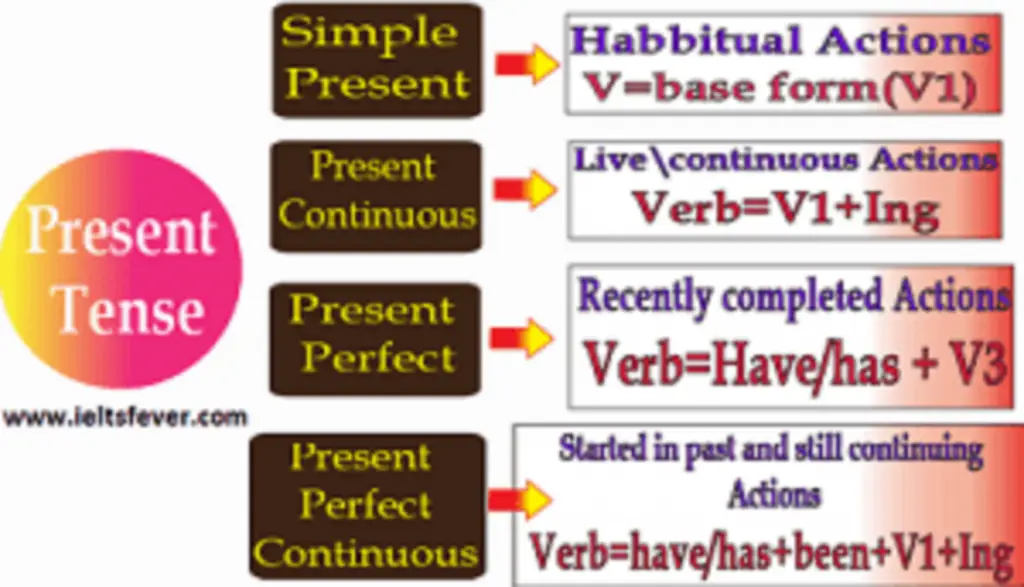
Tenses are forms of a verb that show the time, continuance or completion of an action or a state that is expressed in connection with the moment at which a statement is made about it Lets talk on Present Tenses
Present Tenses:
• Simple Present Tense
• Present continuous Tense
• Present Perfect Tense
• Present Perfect Continuous Tense
Simple Present Tense
The Simple Present is used:
1) To express a habitual action
Ex: He drinks tea every morning.
I get up every day at five o’clock.
My watch keeps good time.
2) To express general truths
Ex: The sun rises in the east.
Honey is sweet.
Fortune favours the brave.
3) In exclamatory sentences beginning with here and there, to express what
is actually taking place in the present.
Ex: Here comes the bus!
There she goes.
4) In vivid narrative, as a substitute for the Simple Past.
Ex: Sohrab now rushes forward and deals a heavy blow to Rustum.
Immediately the Sultan hurries to his capital.
5) To indicate a future event that is part of a plan or arrangement.
Ex: We go to Bombay next week.
They leave tor London by the next mail.
We sail for America next Saturday.
When does the college reopen?
Note: also the other uses of the Simple Present Tense.
1) It is used to introduce quotations
Ex: Keats says, ‘A thing of beauty is a joy for ever’.
2) It is used, instead of the Simple Future Tense, in clauses of time and of
condition.
Ex: I shall wait till you finish your lunch.
If it rains we shall get late.
3) As in broadcast commentaries on sporting events, the Simple Present is
used, instead of the Present Continuous; to I describe activities in progress
where there is stress on the succession of happenings rather than on the
duration.
4) The Simple Present is used, instead of the Present Continuous, with the
type of verbs mentioned below. We must say, for example, ‘I see the
sunrise’, not ‘I am seeing the sunrise’.
- a) Verbs of perception, e.g. see, hear, smell, notice, recognize.
- b) Verbs of emotion, e.g. want, wish, desire, feel, like, love, hate,
hope, refuse, prefer.
- c) Verbs of thinking, e.g. think, suppose, believe, agree, consider, trust,
remember, forget, know, understand, imagine, mean, mind.
Present Continuous Tense
The Present Continuous is used
1) For an action going on at the time of speaking
Ex: She is singing (now).
The boys are playing hockey.
2) For a temporary action which may not be actually happening at the time
of speaking
Ex: I am reading ‘David Copperfield’ (but I am not reading at this moment).
3) For an action that is planned or arranged to take place in the near
future
Ex: I am going to the cinema tonight.
My uncle is arriving tomorrow.
The following verbs, on account of their meaning, are not normally used in
the continuous form:
1) Verbs of perception, e.g. see, hear, smell, notice, recognize.
2) Verbs of appearing, e.g., appear, look, seem.
3) Verbs of emotion, e.g. want, wish, desire, feel, like, love, hate, hope,
refuse, prefer.
4) Verbs of thinking, e.g., think, suppose believe, agree, consider, trust,
remember, forget, know, understand, imagine, mean, mind.
5) have (=possess), own, possess, belong to, contain’, consist of, be
(except when used in the passive).
These verbs are used in the Simple Present. They may, however, be used in the
continuous tenses with a change of meaning.
Ex: I am thinking of (=considering the idea of) going to America.
Mr. Singh is minding (=looking after) the baby while his wife is out
shopping.
Present Perfect Tense
The Present Perfect is used
1) To indicate completed activities in the immediate past.
Ex: He has just gone out.
It has just struck ten.
2) To express past actions whose time is not given and not definite.
Ex: Have you read ‘Gulliver’s Travels’?
I have never known him to be angry.
Mr. Hari has been to Japan.
3) To describe past events when we think more of their effect in the present
than of the action itself.
Ex: “Gopi has eaten all the biscuits (i.e., there aren’t any left for you).
I have cut my finger (and it is bleeding now).
I have finished my work (=now I am free).
4) To denote an action beginning at some time in the past and continuing up
to the present moment.
Ex: I have known him for a long time.
He has been ill since last week.
We have lived here for ten years.
We haven’t seen Padma for several months.
The following adverbs (or adverb phrases) can be used with the Present
Perfect: just, often, never, ever (in questions only), so far, till now, yet (in
negatives and questions), already, since—phrases, for—phrases, today, this
week, this month, etc.
Note: The Present Perfect is never used with adverbs of past time. We should not say, for example, ‘He has gone to Rajahmundry yesterday’. In such cases
the Simple Past should be used (‘He went to Rajahmundry yesterday’).
Present Perfect Continuous Tense
The Present Perfect Continuous is used for an action which began at some
time in the past and is continuing.
Ex: He has been sleeping for five hours (and is still sleeping).
They have been building the bridge for several months.
They have been playing since four o’clock.
This tense is sometimes used for an action already finished. In such cases, the
continuity of the activity is emphasized as an explanation of something.
Ex: ‘Why are your clothes so wet’?’, — ’I have been watering the garden’.
Also Read Past Tenses English Grammar ielts exam

Present Tenses English grammar ielts exam Present Tenses English grammar ielts exam Present Tenses English grammar ielts exam Present Tenses English grammar ielts exam Present Tenses English grammar ielts exam Present Tenses English grammar ielts exam Present Tenses English grammar ielts exam Present Tenses English grammar ielts exam
Discover more from IELTS Fever
Subscribe to get the latest posts sent to your email.