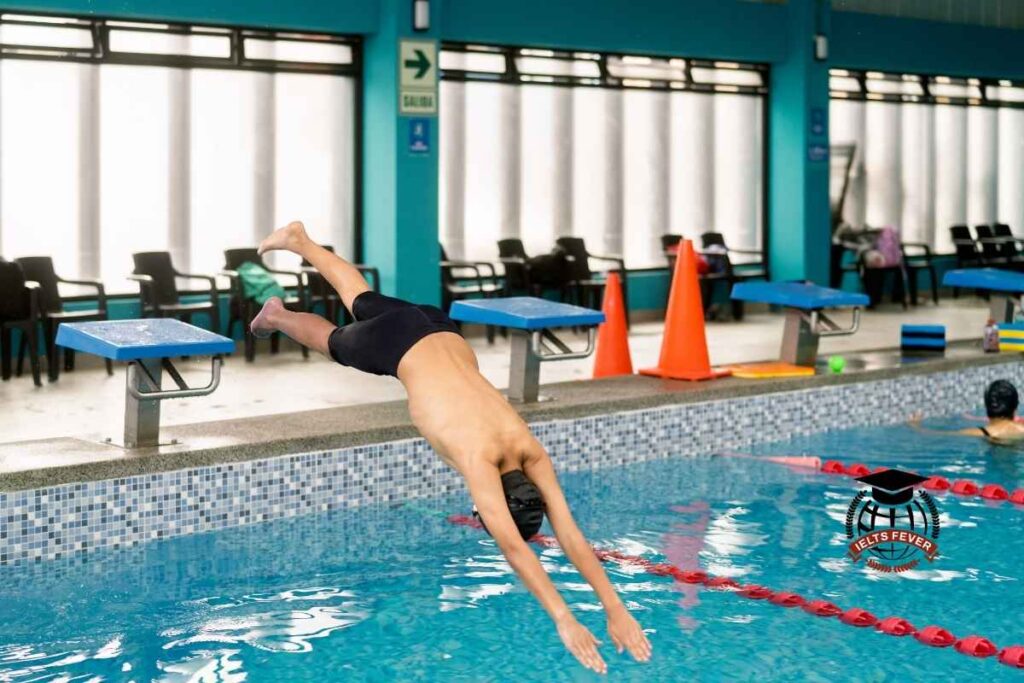
IELTSFever Computer Based General Reading Test 16 is a complete 60-minute reading workout built around the kind of rapid decisions candidates must make on a computer screen. The test contains 40 questions in three sections. It begins with the practical Jubilee Swimming Club Regulations, moves through airport and student information, and finishes with a longer passage about the search for life on Mars.
That variety is exactly what makes this practice useful. You are not simply reading five unrelated texts. You are learning to change your reading method whenever the document and question type change. A short set of rules needs precise scanning. A school notice demands careful comparison. A paragraph-heading task requires you to identify the main purpose, while the final science article tests whether you can follow evidence, opinions and named researchers without losing your place.
Use this guide before starting the test if you want a clear plan, or read it after your first attempt to understand where your method can improve. The discussion is intentionally spoiler-free, so you can practise honestly before checking the official answer page.
Start IELTSFever Computer Based General Reading Test 16
IELTSFever Computer Based General Reading Test 16 at a Glance
| Test feature | What to expect |
|---|---|
| Mode | Computer-based General Training Reading practice |
| Total time | 60 minutes |
| Total questions | 40 |
| Number of sections | 3 |
| Opening text | Jubilee Swimming Club Regulations |
| Other practical texts | Airport information, language-school information and boarding information |
| Longer passage | Mars: Are We Close to Finding Life? |
| Main question types | True/False/Not Given, short answers, multiple choice, matching headings, matching information, Yes/No/Not Given and sentence completion |
| Recommended approach | Complete the timed test first, review evidence second, and check answers last |
The test page starts its timer when you begin, so prepare your desk before opening it. Keep water nearby, silence notifications and use a stable browser window. If you need a quick warm-up, scan the question-type notes below first, but do not open the answer key until you have submitted every response.
Why General Reading Test 16 Is a Valuable CBT Practice Session
Some reading tests focus heavily on one skill. General Reading Test 16 is different because it makes you move between several reading behaviours. The first section rewards attention to conditions, permissions, locations and word limits. Section 2 asks you to compare closely related choices and reduce whole paragraphs to a central idea. Section 3 then increases the reading load and introduces claims, evidence, paragraph locations and scientist attribution.
This progression teaches an important exam habit: never carry one question-solving method blindly into the next task. Reading every word slowly may feel safe in a short notice, but it can consume too much time in a long article. Scanning for a name may work brilliantly for a researcher-completion question, yet it will not automatically reveal the main idea needed for a heading. Strong candidates adjust their method according to the instruction.
The computer format adds another layer. On paper, your eyes can jump across a page quickly. On screen, scrolling can hide the sentence you just read. A practical CBT session therefore trains both comprehension and navigation. IELTSFever Computer Based General Reading Test 16 gives you enough variety to practise that coordination in one sitting.
Complete Passage and Question Map for General Reading Test 16
Knowing the map does not give away any answer. It simply prevents the question type from surprising you during the timed attempt.
Section 1, Questions 1-13: Rules and Airport Services
Questions 1-7 are based on Jubilee Swimming Club Regulations and use True, False and Not Given. The text is short, but the statements are designed to test precision. You must notice whether a rule applies to members, guests, children, a changing room, the pool area or everyone. Small words such as only, must, may, before and unless can completely change the meaning.
Questions 8-13 use an airport-information text and require short answers of no more than three words. The information is arranged by service, location and airport. Your job is to match the situation in the question with the correct service block, then copy only the words needed for the answer. This task rewards scanning, but the word limit and exact location still need a final check.
Section 2, Questions 14-24: School Information and Boarding
Questions 14-18 are multiple-choice questions based on information about a summer language school. The passage includes several practical categories, such as class arrangements, attendance, facilities, homestay and language policy. Wrong choices often sound reasonable because they borrow a detail from the text and alter its condition. Read the stem first, identify its category, and compare every option with the relevant lines.
Questions 19-24 ask you to match headings to paragraphs in a boarding-college text. A correct heading represents the main function of a paragraph, not merely one attractive word inside it. Some paragraphs contain costs, student backgrounds, building arrangements, supervision, accommodation choices or welfare support. Your task is to decide what each paragraph is mainly doing.
Section 3, Questions 25-40: Mars and the Search for Life
The final section uses the longer passage Mars: Are We Close to Finding Life? Questions 25-29 require you to locate specific information in labelled paragraphs. Questions 30-35 use Yes, No and Not Given, so you must compare each statement with what the passage actually claims. Questions 36-40 complete statements with the surname of a person mentioned in the article.
This section is not difficult because it is scientific; it is difficult because several ideas are connected. Water, landscape, possible life, exploration projects and researchers’ views appear across the passage. A quick paragraph map will help you separate those threads.
Use the TRACE Method in IELTSFever Computer Based General Reading Test 16
For this test, use a five-step system called TRACE. It is simple enough to remember under time pressure and flexible enough for every question type.
T – Task
Read the instruction before the passage. Decide whether the task asks for a truth judgement, a choice, a heading, a paragraph letter, a short phrase or a surname. Many lost marks are not comprehension errors; they are instruction errors.
R – Restriction
Identify the restriction attached to the task. It might be a three-word maximum, one letter only, a surname only, or a distinction between True/False/Not Given and Yes/No/Not Given. Keep that restriction visible in your mind while entering the answer.
A – Anchor
Underline or mentally mark two anchors in the question. Good anchors include a location, a person, a time, a service, a technical noun or an unusual action. Avoid relying only on common words because they can appear in several parts of the passage.
C – Compare
Compare the complete meaning, not just matching vocabulary. Ask whether the passage agrees, contradicts, limits or never addresses the statement. For headings, compare the proposed heading with the whole paragraph. For multiple choice, compare all options with the evidence rather than selecting the first familiar phrase.
E – Enter and Evaluate
Enter the answer, then perform a two-second check. Is the spelling accurate? Is the number of words allowed? Did you type a letter when the system needs a word? Does the sentence remain grammatical? This final action is small, but it prevents avoidable mistakes.
How to Solve Jubilee Swimming Club Regulations Questions
The title passage looks straightforward because it is a list of everyday rules. However, rule-based texts are full of boundaries. A statement can use the same nouns as the passage and still change who is affected, where a rule applies or what happens after a violation.
Create a quick mental table with four columns: person, action, condition and result. For example, ask who must perform an action, where it must happen, under what condition it applies and whether a penalty or permission follows. You do not need to write a full table; simply train your eyes to look for these four parts.
For True/False/Not Given, use this evidence rule:
- Choose True only when the passage supports the complete statement.
- Choose False only when the passage supplies evidence for the opposite meaning.
- Choose Not Given when the text does not provide enough information to prove or disprove the claim.
Do not convert your real-world knowledge into passage evidence. A locker may normally be free or paid, but the answer depends only on what the displayed regulations say. Similarly, a fine is not automatically an entry charge, and a rule for one room is not automatically a rule for the entire facility. These scope differences are central to Jubilee Swimming Club Regulations.
How to Handle the Airport Short-Answer Questions
The airport information is visually organised into separate service blocks. Before searching for an answer, identify the question’s service category. Is it asking about general help, shopping, food, medical support, child care or another facility? Once you know the category, scan only the relevant part.
Next, confirm the airport and any time or terminal condition. A service may exist at both locations but be placed in different areas. Another service may be available except in one terminal. The wrong answer often comes from locating the right service but ignoring the place attached to it.
Finally, respect NO MORE THAN THREE WORDS. Copy the smallest complete phrase that answers the question. Do not add an explanatory word just because it makes the response sound more natural. If the passage supplies the required wording, preserve its spelling and number. A correct idea with too many words can still lose the mark.
Multiple-Choice Strategy for the Language-School Text
In Questions 14-18, begin with the question stem and predict the category of information you need. If the stem concerns class size, search the class-size part. If it concerns attendance, facilities, language use or homestay, go directly to that labelled area. The document’s headings are navigation tools, so use them.
Then test each option with evidence. A useful three-label system is:
- Supported: the passage states the same meaning.
- Changed: the option uses a real detail but alters a number, time, condition or consequence.
- Unrelated: the option may sound possible but is not the answer to the stem.
Do not stop when option A looks believable. The task is not to find a believable sentence; it is to find the only choice fully supported by the text. Pay special attention to minimum and maximum figures, eligibility conditions, opening days, notice periods and who can use a facility.
Matching Headings Without Getting Distracted
The boarding passage in General Reading Test 16 is an excellent main-idea exercise. Each paragraph contains several details, but the heading must cover the paragraph as a whole.
Read the first sentence, the final sentence and any repeated idea. Then summarise the paragraph in three to six words before looking closely at the heading list. Your summary might concern affordability, diversity, building layout, supervision, accommodation choices or welfare. This private summary prevents the wording of a tempting heading from controlling your interpretation.
Cross out a heading only when its meaning has clearly been used. Because there are more headings than paragraphs, do not force every option into the text. If two headings seem possible, ask which one explains the greatest number of sentences. A minor facility mentioned once should not outweigh the paragraph’s larger purpose.
A Paragraph Map for the Mars Passage
Before answering Section 3, spend about two minutes making a compact map of paragraphs A-H. Do not write full sentences. Record one or two ideas beside each letter, such as physical conditions, land features, possible life, water evidence, missing-water theories, a mission, a simulation project or future exploration.
This map supports all three tasks in the section:
- For matching information, it narrows the search to one or two paragraphs.
- For Yes/No/Not Given, it directs you to the author’s relevant claim.
- For surname completion, it helps you remember where each researcher is introduced.
When a person’s name appears, note the view attached to that person. Do not group all researchers together. One may discuss a former ocean, another may want more evidence, another may offer a theory about material moving between planets, and another may comment on funding or future missions. The question tests attribution, so the name and claim must remain connected.
True/False/Not Given and Yes/No/Not Given Are Not Identical
Candidates often use the same label automatically, but the two tasks focus on different things. True/False/Not Given normally compares a statement with factual information in a text. Yes/No/Not Given compares a statement with a claim, view or position expressed in the passage.
The decision process is still similar:
- Find the relevant sentence or paragraph.
- Remove decorative wording from the question and identify its core claim.
- Compare subject, action, degree and condition.
- Select agreement, contradiction or absence.
The most common mistake is calling a statement False or No simply because you cannot find it. Missing information is Not Given. Contradiction requires evidence for a different or opposite meaning. In IELTSFever Computer Based General Reading Test 16, this distinction matters in both the opening regulations and the final Mars text.
A Realistic 60-Minute Time Plan
| Stage | Suggested time | Target |
|---|---|---|
| Section 1 | 15 minutes | Questions 1-13 |
| Section 2 | 18 minutes | Questions 14-24 |
| Section 3 | 22 minutes | Questions 25-40 |
| Final review | 5 minutes | Unanswered items, spelling, word limits and accidental clicks |
Use these figures as control points, not rigid laws. If Section 1 takes seventeen minutes but your answers are secure, do not panic. However, if one Not Given decision has already taken two minutes, mark your best evidence-based choice and move on. The final section needs enough time for paragraph mapping and researcher attribution.
A helpful rule is 40 seconds to locate, 40 seconds to decide. If you still have no clear evidence after that, leave a mental flag and continue. One stubborn question should not steal the time required for three later questions.
Computer-Based Reading Habits That Save Time
Keep the Current Question and Evidence Together
When possible, position the passage so the relevant lines remain visible while you consider the answer. Excessive up-and-down scrolling increases the chance of comparing the question with the wrong paragraph.
Use Question Numbers as Navigation Points
Check which questions belong to the current text before reading. When the passage changes, reset your focus. Do not keep searching the previous text for information that belongs to the next block.
Type Exactly What the Task Requires
For copied answers, avoid unnecessary capitals, punctuation and extra words. For letter-based tasks, enter the correct letter format. For surname completion, a full name may break the stated requirement even if you identified the right person.
Review the Answer Box, Not Only the Passage
Candidates sometimes find correct evidence and then mistype the answer. During the final five minutes, inspect every response box. Look for blanks, duplicated answers caused by a click, obvious spelling problems and violations of the word limit.
Common Traps in IELTSFever Computer Based General Reading Test 16
Trap 1: Same Vocabulary, Different Meaning
A statement may repeat words from the passage while changing the relationship between them. Matching vocabulary is a locator, not proof.
Trap 2: Fine, Fee and Price Confusion
Practical texts may mention money for different reasons. A penalty is not necessarily a charge for using a service. Identify what the amount is connected to.
Trap 3: Turning a Limited Rule into a General Rule
If a rule applies in a changing room, to guests, to children below a certain age or before a specific time, preserve that scope. Do not expand it to the whole facility or every person.
Trap 4: Choosing a Heading for One Memorable Detail
A paragraph can mention sport, food, nurses or buildings without making that detail its central purpose. Your heading must summarise the paragraph’s main function.
Trap 5: Confusing the Passage’s View with Your Knowledge
The Mars questions must be answered from the text. Whether a statement seems scientifically sensible today is irrelevant if the passage supports, contradicts or omits it.
Trap 6: Attaching a Claim to the Wrong Researcher
Several surnames appear in the final passage. Build a name-to-view index and verify the surrounding sentence before entering an answer.
Trap 7: Breaking the Word Limit
Count hyphenated or compound expressions carefully and choose the shortest exact phrase supported by the text. Never add introductory words such as the place is unless the answer requires them.
What to Do Before You Press Start
Use this short checklist:
- Set aside one uninterrupted hour plus ten minutes for review after submission.
- Open only the test page you need.
- Make sure the browser zoom is comfortable.
- Keep notifications and messaging apps closed.
- Decide your time checkpoints: 15, 33 and 55 minutes.
- Promise yourself not to check the answer page during the test.
- Read every instruction before reading its passage.
Now open IELTSFever Computer Based General Reading Test 16 and complete all 40 questions in one sitting.
The Best Way to Review Your Result
Your score tells you how many responses were correct. Your review should tell you why the others were wrong. After submitting the test, use the official General IELTS Reading Test 16 answers and create a small error log.
| Question | Type | My reason | Correct evidence | Error category | Rule for next time |
|---|---|---|---|---|---|
| Example | Not Given | I assumed a normal rule | The text did not state it | Assumption | Absence is not contradiction |
Useful error categories include:
- missed qualifier;
- wrong paragraph;
- word-limit error;
- spelling or singular/plural error;
- heading chosen from a detail;
- opinion attached to the wrong person;
- answer changed without evidence;
- time-pressure guess.
Do not merely read the correct answer and move on. Return to the text, find the exact evidence and explain the gap between your choice and the passage. That explanation is where improvement happens.
If you want the original source layout for a second comparison, use the IELTSFever page for General Reading Practice Test 16 and Jubilee Swimming Club Regulations. For additional practice after your review, visit IELTS Reading Test General Module 50+ Samples or the organised collection of General Reading Practice Tests for IELTS.
Seven-Day Improvement Plan After General Reading Test 16
Day 1: Full Diagnostic
Complete the test under the 60-minute limit. Record the score, section timings and any questions you answered without firm evidence.
Day 2: Rules and Not Given Decisions
Revisit Questions 1-7 without looking at your old choices. For each statement, locate the exact supporting line or write “missing” if the idea is absent. Focus on scope words and conditions.
Day 3: Word Limits and Multiple Choice
Redo the airport and language-school tasks. For every short answer, count the words. For every multiple-choice item, write one reason why each rejected option fails.
Day 4: Paragraph Summaries
Read the boarding passage and create a short summary for every paragraph before matching headings. This trains you to separate a topic from a detail.
Day 5: Build a Mars Evidence Map
Map paragraphs A-H, then list each named person and the view connected to that name. Re-answer the final section from your map.
Day 6: Controlled Reattempt
Take IELTSFever Computer Based General Reading Test 16 again, but aim for accuracy rather than speed. Every answer should have a visible reason.
Day 7: Transfer the Method
Try CBT GT Reading Test 17 under full timing. Use the same TRACE method and compare your error pattern with Test 16.
More IELTSFever Practice Resources
Build a balanced weekly routine instead of practising reading alone:
- Explore free General Reading sample tests for daily timed practice.
- Use the IELTS Band Score Calculator to organise your practice results.
- Practise formal and informal letters with IELTS General Writing Task 1 samples.
- Add listening sessions from IELTS Listening Test Sample Papers.
- Visit the IELTSFever CBT home page to choose another computer-based test.
Every content link above belongs to IELTSFever. No third-party study website is required to follow this plan.
Frequently Asked Questions About IELTSFever Computer Based General Reading Test 16
Question 1:- How many questions are in General Reading Test 16?
There are 40 questions divided into three sections. The format moves from shorter everyday texts to a longer article, which makes it suitable for a complete timed practice session.
Question 2:- How much time should I take?
Use a maximum of 60 minutes for the authentic practice attempt. A practical split is 15 minutes for Section 1, 18 minutes for Section 2, 22 minutes for Section 3 and five minutes for checking.
Question 3:- What is the first passage about?
The opening passage is Jubilee Swimming Club Regulations. It presents rules and conditions, followed by True/False/Not Given questions that test careful attention to scope and missing information.
Question 4:- Which question types appear in this test?
The set includes True/False/Not Given, short answers with a word limit, multiple choice, matching headings, matching information, Yes/No/Not Given and sentence completion using surnames.
Question 5:- Should I read every passage completely before answering?
Not always. Preview the questions and instructions first. For short practical texts, targeted scanning is efficient. For paragraph headings and the longer Mars passage, a brief full overview or paragraph map is more useful.
Question 6:- When should I check the answers?
Check them only after submitting all 40 responses. Looking at an answer during the test changes the exercise from assessment into guided practice and makes the final score less useful.
Question 7:- How can I improve my Not Given accuracy?
Demand evidence for both agreement and contradiction. If the text does not settle the exact claim, choose Not Given. Do not use general knowledge or assumptions about how a club, airport, school or planet should work.
Question 8:- Is this test useful for computer-based IELTS preparation?
Yes. It helps you practise reading, scrolling, moving between question groups, typing short responses and controlling a visible timer. Treat the attempt as a complete screen-based rehearsal.
Final Advice
IELTSFever Computer Based General Reading Test 16 is most useful when you treat it as a decision-making test rather than a speed-reading race. Read the instruction, notice the restriction, locate an anchor, compare the complete meaning and check the answer you enter. That TRACE habit works across every part of this paper, from Jubilee Swimming Club Regulations to the final researcher-attribution questions.
Complete the test without interruptions, protect enough time for Section 3 and review mistakes through evidence rather than memory. A score is only the starting point. When you can explain why an option is supported, contradicted or absent, you are building the control needed for a higher reading band.
Take IELTSFever Computer Based General Reading Test 16 now
Follow IELTSFever
Get new practice material, strategy updates and study reminders through the official IELTSFever profiles:
Discover more from IELTS Fever
Subscribe to get the latest posts sent to your email.