The Chart Below Shows the Percentage of People Born in And Outside Australia Living in Cities, Towns, and Rural Areas in 1950 and 2010. Summarise the Information by Selecting and Reporting the Main Features, and Make Comparisons Where Relevant.
 Sample 1: The Chart Below Shows the Percentage of People Born in And Outside Australia Living
Overall, the data reveals a striking trend towards urbanization over the 60-year period. In both categories—people born in Australia and those born overseas—there was a significant increase in the proportion living in cities, while the percentages of those residing in rural areas dropped considerably.
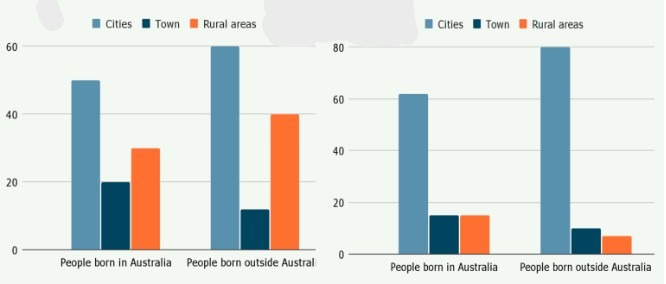
In 1950, approximately 50% of Australian-born individuals lived in cities, while around 30% resided in rural areas and the remaining 20% in towns. Among those born outside Australia, the urban population was slightly higher, at 60%, with a substantial 40% living in rural areas and virtually none in towns.
By 2010, there was a notable demographic shift. The proportion of people living in cities had surged to roughly 65% for Australian-born residents and to an even more significant 80% for those born overseas. Conversely, rural areas experienced a dramatic decline: only about 15% of native Australians and just 5% of immigrants lived in rural regions. Town populations remained relatively stable for the Australian-born group, holding at around 15%, but increased slightly for people born outside Australia to approximately 15% as well.
In summary, the data clearly illustrates a widespread migration towards urban areas between 1950 and 2010. This urban drift was more pronounced among people born outside Australia, accompanied by a sharp reduction in rural populations across both groups.
Sample 2: The Chart Below Shows the Percentage of People Born in And Outside Australia Living
It is immediately evident that urban living became significantly more common over time for both groups, while rural residency sharply declined. Cities consistently attracted the majority population, especially among those born outside Australia.
In 1950, around half of the Australian-born population lived in cities, with the rest split between rural areas (approximately 30%) and towns (about 20%). People born outside Australia showed an even stronger preference for urban living, with 60% residing in cities and the remaining 40% in rural areas, while almost none lived in towns.
By 2010, the proportion of people living in cities had increased across the board. Roughly 65% of those born in Australia and 80% of those born elsewhere were living in urban areas. At the same time, the rural population dropped drastically—only about 15% of the native-born and less than 10% of foreign-born individuals remained in rural settings. Town populations remained steady among the Australian-born group (close to 15%) and increased slightly for those born overseas, rising to just under 15%.
To conclude, the data highlights a strong shift from rural to urban living between 1950 and 2010, with foreign-born individuals showing the most dramatic change in residential patterns.
Follow Us on The IELTSFever Facebook Page for more updates
Discover more from IELTS Fever
Subscribe to get the latest posts sent to your email.