The Diagram Below Shows how Bricks Are Manufactured for The Building Industry. Summarise the Information by Selecting and Reporting the Main Features, and Make Comparisons Where Relevant.
 Sample Answer: The Diagram Below Shows how Bricks Are Manufactured for The Building Industry
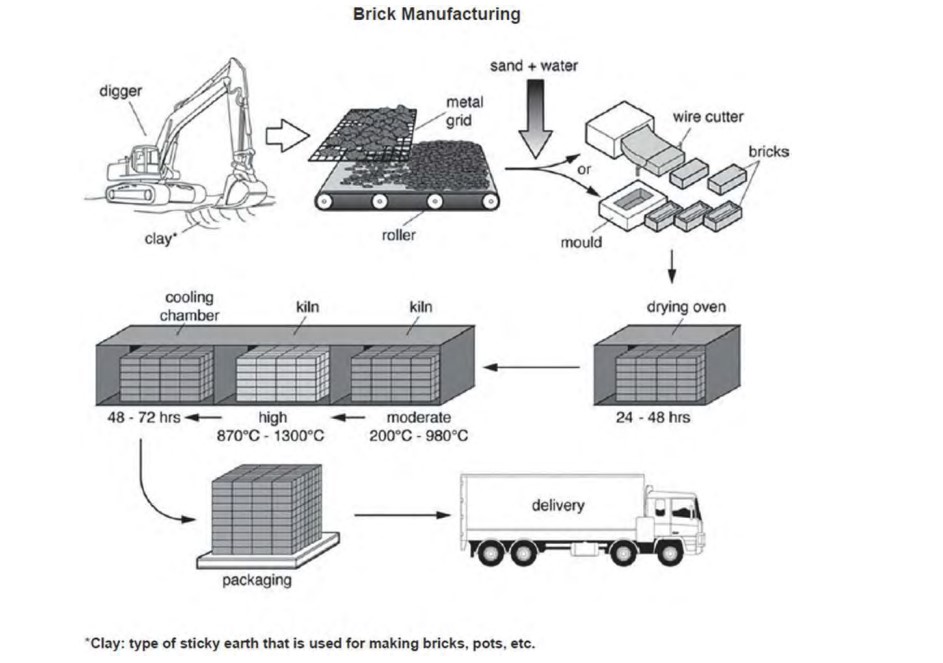
The diagram illustrates the stages involved in producing bricks for the construction industry. Overall, the process consists of seven main steps, beginning with digging clay and ending with the delivery of finished bricks to customers.
The first stage involves using a digger to extract clay from the ground. The clay is then placed onto a metal grid, where larger pieces are broken down, and finer particles are allowed to pass through onto a roller. Next, sand and water are added to the clay mixture to achieve the right consistency.
This mixture is then shaped into bricks either by using a mould or a wire cutter. Once formed, the wet bricks are placed in a drying oven for 24 to 48 hours to remove excess moisture.
After drying, the bricks are transferred into a kiln, where they are first heated moderately between 200°C and 980°C, and then subjected to a high temperature range of 870°C to 1300°C. This two-step heating process strengthens the bricks. Following this, the hot bricks are moved to a cooling chamber for 48 to 72 hours to lower their temperature gradually.
In the final stages, the cooled bricks are packaged and transported by truck to building sites or retailers.
Overall, the brick manufacturing process is a systematic, multi-stage procedure that involves physical preparation, heating, and cooling to produce durable building materials ready for distribution.
Discover more from IELTS Fever
Subscribe to get the latest posts sent to your email.