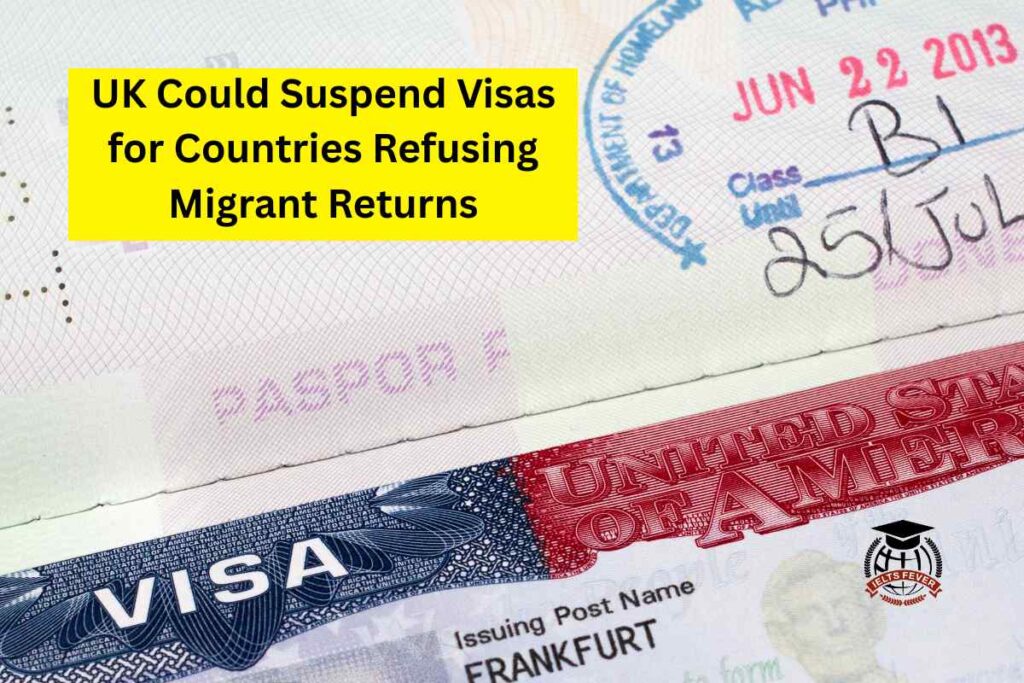
The UK government is considering a new immigration policy that could see visas suspended for citizens of those countries that refuse to accept back their nationals who have no right to remain in Britain. Newly appointed Home Secretary Shabana Mahmood mentioned this proposal as part of her plan to strengthen border security and tackle rising illegal migration.
Home Secretary’s First Statement
On Friday, publicly speaking for the first time since her appointment ,Mahmood said her top priority is securing the UK’s borders. She identified one of the biggest challenges as returning foreign nationals who are in the UK illegally but whose home countries refuse to cooperate in taking them back.
“We believe there is interesting space for collaborating, particularly on how we deal with countries who do not accept their citizens back,” Mahmood said. “If ones has no right to be in our country, we must be able to return them to their home nation. For countries that do not play ball, we have been talking about taking much more coordinated action between the Five Eyes countries.”
The Five Eyes alliance, which includes the UK, the United States, Canada, Australia, and New Zealand, is primarily known for intelligence sharing. Mahmood suggested that this partnership could also allow the UK to adopt a unified strategy on migration, including the possibility of cutting or suspending visas for uncooperative countries.
Behind her speech “The message is clear: if your citizens have no right to remain here, you must take them back,”
Rising Migration Pressures
Illegal migration has become one of the UK’s most pressing issues. Thousands of people attempt to cross borders in small boats each year, many seeking asylum. According to Home Office figures, more than 30,000 individuals have arrived in the UK by small boats so far this year, a 37% increase compared to last year. Mahmood explained this situation as “utterly unacceptable,” vowing stronger measures to curb illegal crossings.
Prime Minister Keir Starmer has also emphasized a firmer approach. In June, he indicated t hat visa access could be linked to how well countries cooperate with the UK in returning failed asylum seekers. A Downing Street spokesman said recently that cooperation among Five Eyes allies on illegal migration provides “another tool in our armoury” and reflects the government’s determination to “use every lever at our disposal” to manage migration.
Countries Likely to Be Affected
While Mahmood did not name specific countries, migration experts have highlighted several nations where cooperation on returns is historically low, including India, Bangladesh, Pakistan, and Nepal. These countries also have high demand for UK visas.
Dr Madeleine Sumption, director of the Migration Observatory at Oxford University, explained that how countries respond to visa threats will vary depending on how much they value visa access for their citizens. “Some countries, such as India, have a long history of lobbying for visa access, which could make them more responsive. Others may not see it as a priority,” she said.
Visa restrictions could impact not only migration cooperation but also education, business, and trade relations. India, for example, sends tens of thousands of students to British universities each year, while Pakistan, Bangladesh, and Nepal also supply skilled workers in sectors such as healthcare and technology.”
Challenges in Returning Migrants
Returning migrants to their home countries is a longstanding challenge. Some countries refuse to issue travel documents for rejected asylum seekers, while legal and human rights issues often delay removals.
At the same time, demand for UK visas continues to grow. Students, skilled workers, and family members from South Asia are among the largest groups seeking entry. Any move to restrict visas as a diplomatic lever must balance enforcement with humanitarian and economic considerations.
Critics warn that tying visas to migration cooperation could negatively affect legitimate travelers, including students and professionals who contribute to the UK economy. Charities and human rights groups also caution that enforcement alone does not address the root causes of migration, such as conflict, poverty, and climate change.
Looking Ahead
At present, the UK government has not set a timeline for implementing visa suspensions. Mahmood said discussions are ongoing both domestically and with Five Eyes partners. Any final policy is expected to form part of a broader strategy to reduce illegal migration, secure borders, and ensure that the UK’s immigration system is fair and controlled.
Observers will be watching how countries with high visa demand respond to the possibility of restrictions. If implemented, visa suspensions could become a significant diplomatic tool, demonstrating the UK’s commitment to border control while potentially straining international relations.
Conclusion
The debate over visa suspensions reflects the UK government’s effort to balance border security, international relations, and humanitarian obligations. By leveraging visa access, the UK aims to pressure countries to cooperate in returning nationals who have no right to remain. However, the policy also carries risks, including diplomatic tensions and unintended impacts on legitimate travelers.
With record numbers of small boat crossings and public pressure mounting, the government appears determined to explore all options. Whether visa suspensions will effectively encourage cooperation, or remain a politically and diplomatically sensitive tool, remains to be seen.
Discover more from IELTS Fever
Subscribe to get the latest posts sent to your email.