
The Chart Below Shows the Price in Euros of 800 Grams of Four Types of Bread in One European Country from 2001 to 2006. Summarise the Information by Selecting and Reporting the Main Features, and Make Comparisons Where Relevant.
 Sample Answer: The Chart Below Shows the Price in Euros of 800 Grams of Four Types of Bread
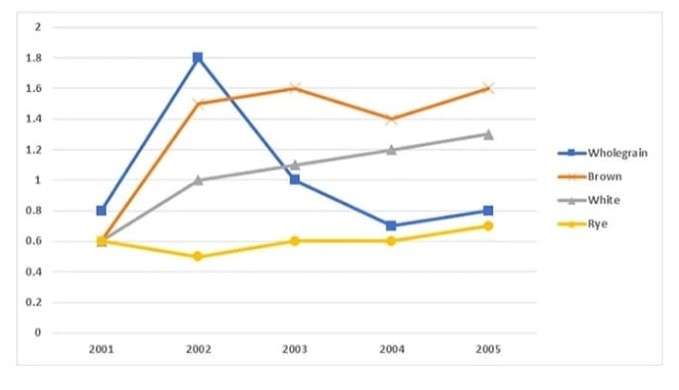
The line graph compares the prices, in euros, of 800 grams of four types of bread—wholegrain, brown, white, and rye—in a European country between 2001 and 2005.
Overall, brown and white bread showed an upward trend over the period, while wholegrain bread fluctuated considerably and eventually declined. Rye bread remained the cheapest type throughout the years, with only minor price changes.
In 2001, the prices of brown, white, and rye bread were identical at €0.6, whereas wholegrain bread was slightly more expensive at €0.8. The following year, the price of wholegrain bread rose sharply to €1.8, making it the most expensive variety. Brown bread also increased significantly to €1.5, while white bread climbed to €1.0. In contrast, rye bread fell slightly to €0.5.
From 2003 onwards, wholegrain bread experienced a steady decline, dropping to €1.0 in 2003 and reaching a low of €0.7 in 2004 before recovering marginally to €0.8 in 2005. Brown bread remained relatively stable at a high level, fluctuating between €1.4 and €1.6 and ending the period at €1.6, the highest price among all four types. Meanwhile, white bread increased gradually from €1.1 in 2003 to €1.3 in 2005. Rye bread showed only slight variation, rising from €0.5 in 2002 to €0.7 by the end of the period.
Overall, brown bread became the most expensive type by 2005, while rye bread consistently remained the least costly.
Follow Us on The IELTSFever Facebook Page for more updates
Discover more from IELTS Fever
Subscribe to get the latest posts sent to your email.